
How to Find Adjustable Wedge Pillows for Pain Relief
Waking up with a stiff neck, an aching lower back, or that burning sensation in your chest can derail your entire day. You’ve tried stacking regular pillows, but they collapse by midnight, leaving you flat and uncomfortable again. The real issue isn’t sleep—it’s support. You need a solution that adapts to your body, not the other way around. That’s exactly where adjustable wedge pillows come into play. These versatile supports elevate specific body parts to reduce pressure, improve alignment, and target the root cause of your discomfort. Let’s break down exactly how to choose the right one for your unique pain points and get you sleeping soundly again.
What Exactly Is an Adjustable Wedge Pillow and How Does It Work?
An adjustable wedge pillow is a multi-layered foam support system that allows you to change the height and firmness by adding or removing internal layers. Unlike a one-size-fits-all foam triangle, this design gives you personalized control over your sleeping posture, which is crucial for effective pain relief.
The Core Mechanism Behind Pain Relief
The primary function is to use gravity to your advantage. By elevating your head, legs, or back, you reduce pressure on specific nerves and joints. For example, elevating your head prevents stomach acid from traveling upward (acid reflux), while elevating your legs helps blood flow back to your heart, reducing swelling and lower back strain.
Adjustable vs. Fixed Wedge Pillows
- Fixed: One solid piece with a set height. It works for one specific need but isn’t versatile.
- Adjustable: Contains removable layers (usually 2-3 inches thick). This allows you to start low and build up, which is safer for your neck and back.
Who Should Consider One?
If you suffer from acid reflux, sleep apnea, edema, sciatica, or chronic back pain, this is a practical tool. It’s also beneficial for anyone who sleeps on their back but struggles to stay in that position.
Why Does Sleep Position Cause or Worsen Body Pain?
Your sleep position directly dictates the alignment of your spine. When your spine is twisted or unsupported, muscles work overtime to stabilize you, leading to stiffness and pain in the morning. A wedge pillow restores neutral alignment.
The Problem with Flat Sleeping Surfaces
Sleeping perfectly flat often hyperextends the lower back or leaves a gap between the mattress and your neck. This causes the surrounding muscles to contract all night long. Elevation helps maintain the natural “S” curve of your spine.
How Elevation Reduces Nerve Compression
For conditions like sciatica, a flat position can put direct pressure on the sciatic nerve. By bending the knees with a leg wedge, you release tension on that nerve. Similarly, a slight head raise can alleviate pressure on the cervical spine.
Practical Example: The Side Sleeper Dilemma
Side sleepers often wake up with numb arms because their shoulder is compressed. While a wedge isn’t a replacement for a body pillow, placing a small wedge under the waist can prevent the top leg from pulling the pelvis out of alignment.
Which Adjustable Wedge Pillow Height Is Best for Back Pain?
For lower back pain, the best height is typically between 6 and 12 inches for the legs, but it depends on whether you are elevating your legs or your torso. For torso elevation (acid reflux), 6 to 8 inches is the sweet spot.
Measuring the Right Incline Angle
Aim for a 15 to 30-degree incline. This is steep enough to prevent reflux but low enough to avoid sliding down. For leg elevation, you want the knees bent to a 90-degree angle or slightly less.
Why Too High Is Worse Than Too Low
If you elevate your head too steeply, you can strain your neck muscles. You also increase the risk of slipping down the pillow, which causes your lower back to arch. Start with the lowest setting for the first few nights.
Using Layers to Customize Fit
Take out one layer to test the angle. If your hips are still digging into the mattress, you need more height. If you feel pressure behind the knees, you need less. The adjustment should take about 3-4 nights to nail down.
How to Use an Adjustable Leg Wedge for Sciatica and Lower Back Relief
To relieve sciatica, you should use the wedge under your knees and calves while lying on your back. This maintains a slight bend in the hip, which reduces tension on the sciatic nerve as it passes through the piriformis muscle.
Step-by-Step Leg Positioning
- Lie flat on your back with a standard pillow under your head.
- Place the adjustable wedge so the high end is behind your knees.
- Adjust the layers so your knees are slightly bent—not flat, not sharply bent.
- Let your heels sink into the mattress to keep your lower back in contact with the bed.
The “Zero Gravity” Concept
This position mimics a zero-gravity chair by distributing weight evenly. It reduces spinal compression by up to 75% compared to lying flat. Even a 20-minute rest in this position can significantly dial down back spasms.
Common Mistakes to Avoid
- Placing the wedge under the entire legs: This forces the thighs to compress against the stomach.
- Using it too stiff: Firm foam is good, but if it doesn’t compress an inch under your weight, it’s too hard.
Can an Adjustable Wedge Pillow Help with Acid Reflux and Heartburn?
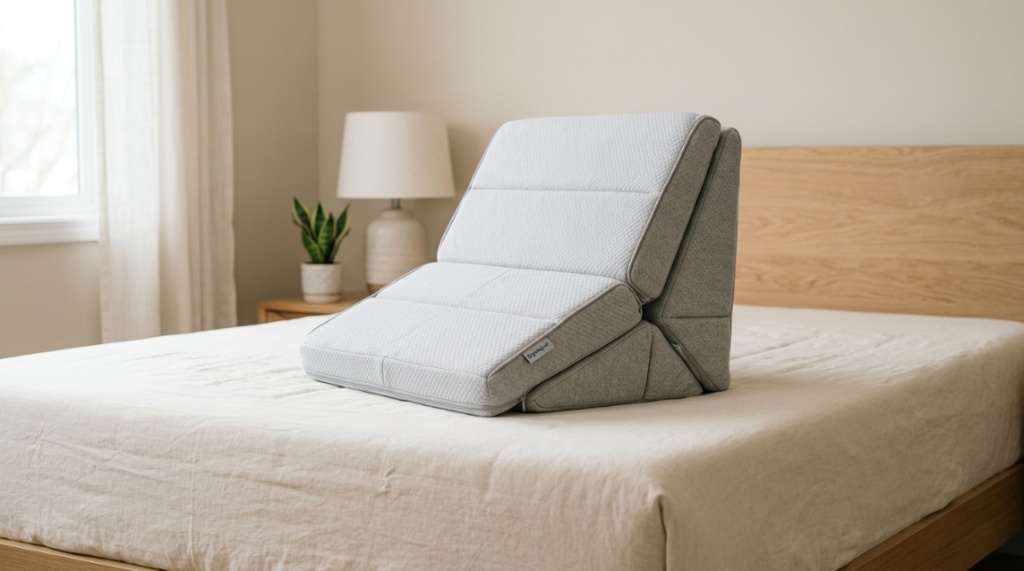
Yes. Elevating your head and chest by 6 to 8 inches uses gravity to keep stomach acid in your stomach. This is one of the most doctor-recommended non-medical solutions for nighttime reflux,When searching for the right elevation to alleviate muscle soreness, local climate, comfort preferences, and firmness levels all play a role. If you are shopping locally or looking for regional availability, you can also check out this guide to help you Pick a Pillow for Back Pain in Washington to ensure proper spinal support.
The Angle Matters: Why 45 Degrees Is a Myth
You don’t need to sit upright at 45 degrees. Research shows a 20-degree incline is sufficient to prevent most reflux episodes. Sitting too upright can actually curl your torso and increase abdominal pressure.
Full Torso vs. Just the Head
A full torso wedge is more effective than a head-only wedge. If your head is elevated but your waist is flat, your stomach bends in the middle, creating a fold that pushes acid upward. The wedge must support your entire upper back and shoulders.
Combining with a Contour Pillow
You might feel a gap between your neck and the wedge. Use a thin cervical pillow on top of the wedge to support the neck curve. This prevents jutting your chin forward.
How to Distinguish Quality Materials in a Wedge Pillow
A quality adjustable wedge pillow should use high-density foam (at least 1.8 lbs per cubic foot) with a removable, washable cover. If the foam feels like a sponge, it will compress quickly and lose its shape.
Memory Foam vs. Polyurethane vs. Latex
| Material | Pros | Cons |
|---|---|---|
| Memory Foam | Contours to body, pressure-relieving | Can sleep hot, holds bacteria |
| Polyurethane | Firmer, more stable for torso elevation | Hard on hips for side sleepers |
| Latex | Natural, breathable, bouncy | Expensive, heavy |
Indentation Load Deflection (ILD) Scale
Look for foam with an ILD of 18-22 for the base layer (support) and 14-16 for the top layer (comfort). If the ILD is too high, it won’t conform; if too low, it will bottom out.
Certifications to Check
- CertiPUR-US: No harmful chemicals, low VOC emissions.
- OEKO-TEX: Safe for skin contact.
When Should You Replace Your Adjustable Wedge Pillow?
You should replace it if you notice sagging or a permanent indentation or if you wake up with new pain points. Typically, a high-quality wedge lasts 2-3 years with daily use.
Signs of Foam Breakdown
If the layers are visibly compressed (thin lines at the edges), the foam has lost its supportive cells. If you can press down to the base with one finger, it’s time for a new one.
Hygiene Considerations
Sweat, dead skin, and dust mites accumulate in the foam. Even if you have a cover, the inner foam degrades faster if not air-dried regularly. Vacuum the foam monthly to extend its life.
Are There Any Risks or Downsides to Sleeping on a Wedge?
Yes, there are two main risks: knee hyperextension and neck strain. Both are preventable with correct positioning, but they shouldn’t be ignored.
The “Sliding Down” Problem
If your sheets are slippery, you will slide down during the night. This leaves your lower back unsupported. Use a grippy fitted sheet or place a non-slip pad under the wedge.
Potential Circulation Issues
When elevating legs, ensure the pressure is on the calves, not the back of the knees. Pressure on the popliteal vein can restrict blood flow. Check that you can easily slide a finger under the knee.
Who Should Consult a Doctor First?
If you have congestive heart failure, severe respiratory disease, or recent spinal surgery, talk to a professional. Gravity changes can shift fluid balance in the body, which isn’t safe for everyone.
How Much Should You Spend on a Quality Adjustable Wedge Pillow?
You should expect to spend between $80 and $150 for a reputable, durable adjustable wedge pillow. Anything less than $50 often lacks the density required for long-term support.
Budget vs. Premium Features
- Under $70: Basic foam, limited adjustment heights, non-washable cover.
- $70–$120: Multiple layers (usually 3), zippered cover, CertiPUR-US foam.
- $120+: Bamboo covers, egg-crate texture, higher ILD foam.
Warranty & Trial Periods
Always check for a 1-year warranty against foam defects. Reputable brands offer a 30-60 night sleep trial. If you don’t feel relief in that window, return it. A good warranty is a sign of manufacturing confidence.
For a curated list of top-rated options that balance cost and quality, exploring specific reviews can save you hours of research. When you compare features side-by-side, you’ll see why some models stand out significantly from the crowd. You can find a comprehensive breakdown of the best budget-friendly models that specifically address adjustable wedge pillows pain relief to help you narrow down your choice without guessing.
What Features Should You Look for in the Best Adjustable Wedge Pillow?
Look for a pillow with at least two removable layers, a zippered cover, and a high-density foam base. Also, check the dimensions to ensure it fits your body width—it should be wider than your shoulders.
Cover Zipper Quality
A metal zipper is more durable than plastic. If the zipper breaks, the foam layers will slide around. Look for a cover that has a separate internal zipper for the foam and an external one for washing.
Non-Slip Base Features
Some wedge pillows have a PVC-free rubber mesh on the bottom. This prevents the pillow from pushing away from the headboard when you lean back. This is essential for sitting up and reading.
Portability & Storage
If you travel, look for a model that can be vacuum-sealed or one that has a carrying handle. The bulkiness of a standard wedge makes it hard to pack.
How to Break In and Maintain Your New Wedge Pillow for Optimal Support
Allow 24 hours for the foam to fully expand after unpacking. Then, sleep on the lowest setting for the first night. Increase height gradually to let your muscles and joints adapt to the new position.
Cleaning Procedures
- Cover: Wash in cold water on a gentle cycle. Air dry only.
- Foam: Do not machine wash. Spot clean with a damp cloth and mild detergent.
- Deodorizing: Sprinkle baking soda on the foam, let sit for 30 minutes, then vacuum.
Fluffing and Rotation
Rotate the wedge 180 degrees every month to even out wear. If the pillow has a top layer and bottom layer, swap their positions if they are sized identically to distribute compression.
Frequently Asked Questions
Can adjustable wedge pillows make back pain worse?
Yes, if used incorrectly. If the wedge is too high under the knees, it can overstretch the hip flexors. If it’s too high under the head, it can strain the cervical spine. Start low and increase gradually.
Is it okay to sleep on an adjustable wedge pillow all night?
Absolutely, provided you are comfortable. Many people use them for 8 hours. However, if you are a restless sleeper, you might slide down. Use a non-slip cover to stay put.
Can I use an adjustable wedge pillow with a regular pillow?
Yes. For side sleepers, place a standard pillow between your knees to keep the hips square. For back sleepers, a thin pillow under the head complements the wedge’s incline.
Which side of the wedge pillow goes up?
The thick edge goes at your back for torso elevation. The thick edge goes behind the knees for leg elevation. The thin edge is always at the end of the bed or the tailbone.
Do doctor’s recommend wedge pillows for sleep apnea?
Yes, mild to moderate sleep apnea can benefit from elevating the head. A wedge pillow can reduce airway collapse by keeping the throat aligned. It is not a cure but a management tool.
How long does a memory foam wedge pillow last?
On average, 2 to 3 years. If you weigh over 230 lbs, you may need to replace it sooner because the foam compresses faster. Vacuuming it monthly can extend its lifespan.
Can I use a wedge pillow for sitting up in bed?
Yes. The high incline is excellent for reading, working, or watching TV. It provides lumbar support that standard stack pillows cannot deliver.
Conclusion
Finding the right adjustable wedge pillow is not about getting the highest one—it’s about getting the right alignment. Each layer you add or remove changes the pressure points on your spine. Start with the lowest setting, listen to your body, and adjust over the course of a week. Focus on the material density, the zipper quality, and the specific placement for your condition. Whether you are battling acid reflux, sciatica, or simply morning stiffness, this tool offers a customizable path to better sleep. Don’t settle for a one-size-fits-all product; invest in one that grows with your comfort preferences and provides instant feedback. Once you experience a full night without pain, you’ll never go back to flat sleeping again.













Post Comment